

VOCATIONAL REHABILITATION | STRENGTH DEMANDS
NOV 4 2026 | HM VOCATIONAL CONSULTING
Why differences in occupational strength classifications matter in vocational assessment, disability management and return-to-work planning.
When reviewing vocational recommendations, we often see occupations described as requiring limited, light, medium or heavy physical strength.
These classifications are useful, particularly when identifying potential employment alternatives or considering whether an occupation is consistent with someone's documented functional abilities. However, functional capacity evaluations (FCEs) and clearly defined physical tolerances are not always available, making the more detailed occupational demands information in OaSIS particularly valuable.
But what happens when the systems used to describe those demands change?
With the transition from the National Occupational Classification (NOC) Career Handbook to the Occupational and Skills Information System (OaSIS), vocational rehabilitation professionals have had to become familiar with a different approach to occupational strength ratings.
One of the more important changes involves how the amount and frequency of physical effort are described.
How the Career Handbook classified strength
The Career Handbook classified occupational strength demands into four broad categories: Limited (S1), Light (S2), Medium (S3) and Heavy (S4). In comparison, OaSIS uses a five-level Static Strength rating scale (Levels 1–5), ranging from the lowest to the highest strength requirements, with consideration given to the amount of force exerted and the frequency of the activity. For example:
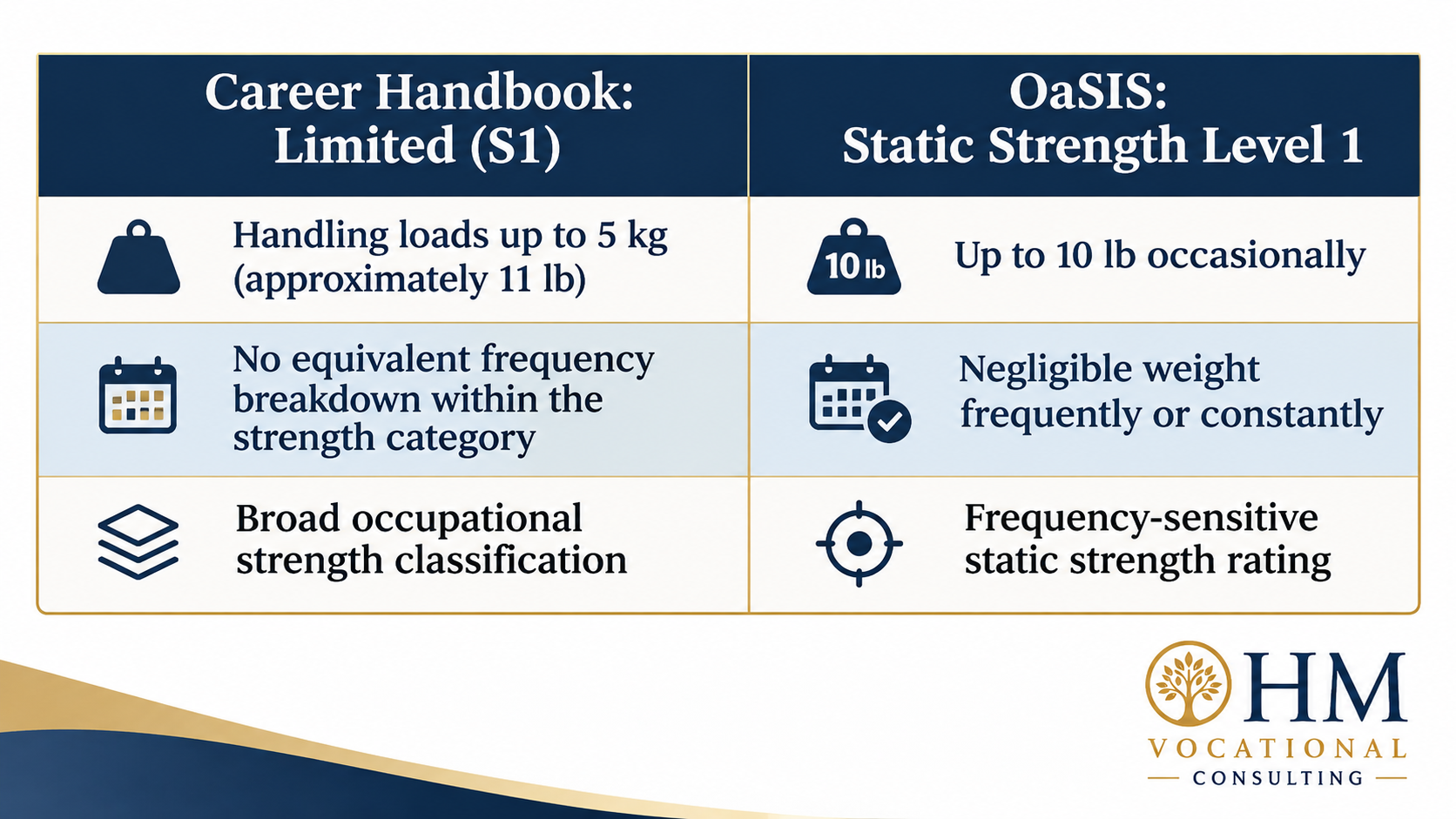
Although the Career Handbook and OaSIS both describe occupational requirements, they use different rating approaches. The Career Handbook's aptitude ratings were norm-referenced, meaning they were interpreted relative to a reference population, while OaSIS ability ratings are criterion-referenced, meaning they are based on defined levels of occupational requirements. For physical strength specifically, the Career Handbook used broad weight-based categories, whereas OaSIS provides more detailed criteria that consider both the amount and frequency of physical effort. These differences mean the strength ratings should not be treated as directly equivalent.
OaSIS distinguishes Static Strength from other strength-related abilities, including Dynamic Strength, Explosive Strength and Trunk Strength. It also provides separate ratings for other occupational demands, such as sitting, standing, body positioning and additional physical abilities.
This is particularly important because a low static strength rating does not necessarily mean an occupation has minimal physical demands in every respect.
Why lifting frequency matters
Consider an individual whose functional documentation identifies a lifting restriction of 10 pounds occasionally. An occupation with a Static Strength Level 1 rating may appear consistent with that particular restriction. However, the rating alone does not establish that the occupation is suitable.
We would still need to consider other documented functional abilities and occupational requirements, such as standing, walking, reaching, repetitive movements or sustained postures, where relevant to the available evidence.
The same principle applies when reviewing occupations previously classified as Limited or Light under the Career Handbook. Knowing the weight of a load is helpful. Understanding how frequently that load must be handled provides additional information. Neither classification should replace consideration of the actual occupational duties or available functional evidence.
What does this mean for vocational assessment?
When identifying employment alternatives, occupational databases provide a starting point for analysis and they help us understand the typical characteristics and requirements of an occupation. However, an occupational rating is not an individualized assessment of someone's ability to perform that work.
In vocational evaluations, transferable skills analyses and return-to-work planning, the interpretation of occupational strength demands should be considered alongside the individual's education, training, employment experience and documented functional abilities.
Where a specific job is being considered, information about its actual duties and physical requirements may also be necessary. This is especially relevant when an occupation appears suitable based on its classification but the available functional evidence raises questions about particular tasks.
Is there still value in the Career Handbook?
I believe there is, particularly when reviewing historical vocational assessments or interpreting findings developed using the older framework. The Career Handbook provides context for understanding how occupational strength demands were previously classified, while OaSIS offers a more detailed set of descriptors that can support contemporary occupational analysis.
For me, the transition is not about treating the two systems as interchangeable or relying on historical classifications in place of current occupational information, but it’s about understanding what each source measures, recognizing its limitations and using that information appropriately.
Looking beyond the rating
Whether an occupation is classified as Limited under the Career Handbook or assigned Static Strength Level 1 in OaSIS, the rating is only one part of the vocational picture and a well-supported vocational analysis considers the relevant occupational requirements, the available functional evidence and the individual's vocational background. The goal is not simply to identify occupations that fall within a particular strength category, but to determine whether the evidence supports their consideration as reasonable employment alternatives.
About HM Vocational Consulting
HM Vocational Consulting provides vocational rehabilitation, transferable skills analysis, employment and career planning, return-to-work planning, and professional practice development services across Canada.
Our approach emphasizes individualized vocational planning, evidence-informed practice and collaboration to identify and address employment barriers.
Heather Mallard, CVRP-TSA, ICVE, CCVE, RVP, Vocational Evaluator & Rehabilitation Professional | HM Vocational Consulting
About the Author Heather Mallard is a vocational evaluator and rehabilitation professional and the founder of HM Vocational Consulting. Her work focuses on vocational assessment, rehabilitation, return to work, and the relationship between work, identity and meaning.
