

VOCATIONAL REHABILITATION | SEDENTARY MEANING
OCT 30 2026 | HM VOCATIONAL CONSULTING
The term sedentary is frequently used in vocational rehabilitation, disability management, and return-to-work planning. Yet, despite how commonly it appears in referrals, medical documentation, and vocational reports, it isn't always interpreted the same way.
For some professionals, sedentary work refers to occupations with minimal lifting and other strength requirements. For others, it means work performed predominantly while sitting. Sometimes, both characteristics are assumed.
While these interpretations may overlap, they are not necessarily interchangeable. Understanding the distinction is important when evaluating occupational demands and determining whether potential employment options are consistent with an individual's functional abilities, restrictions, and limitations.
Understanding Sedentary Physical Demands
One commonly used framework in vocational evaluation is Leonard N. Matheson's Physical Demand Characteristics of Work (1993).
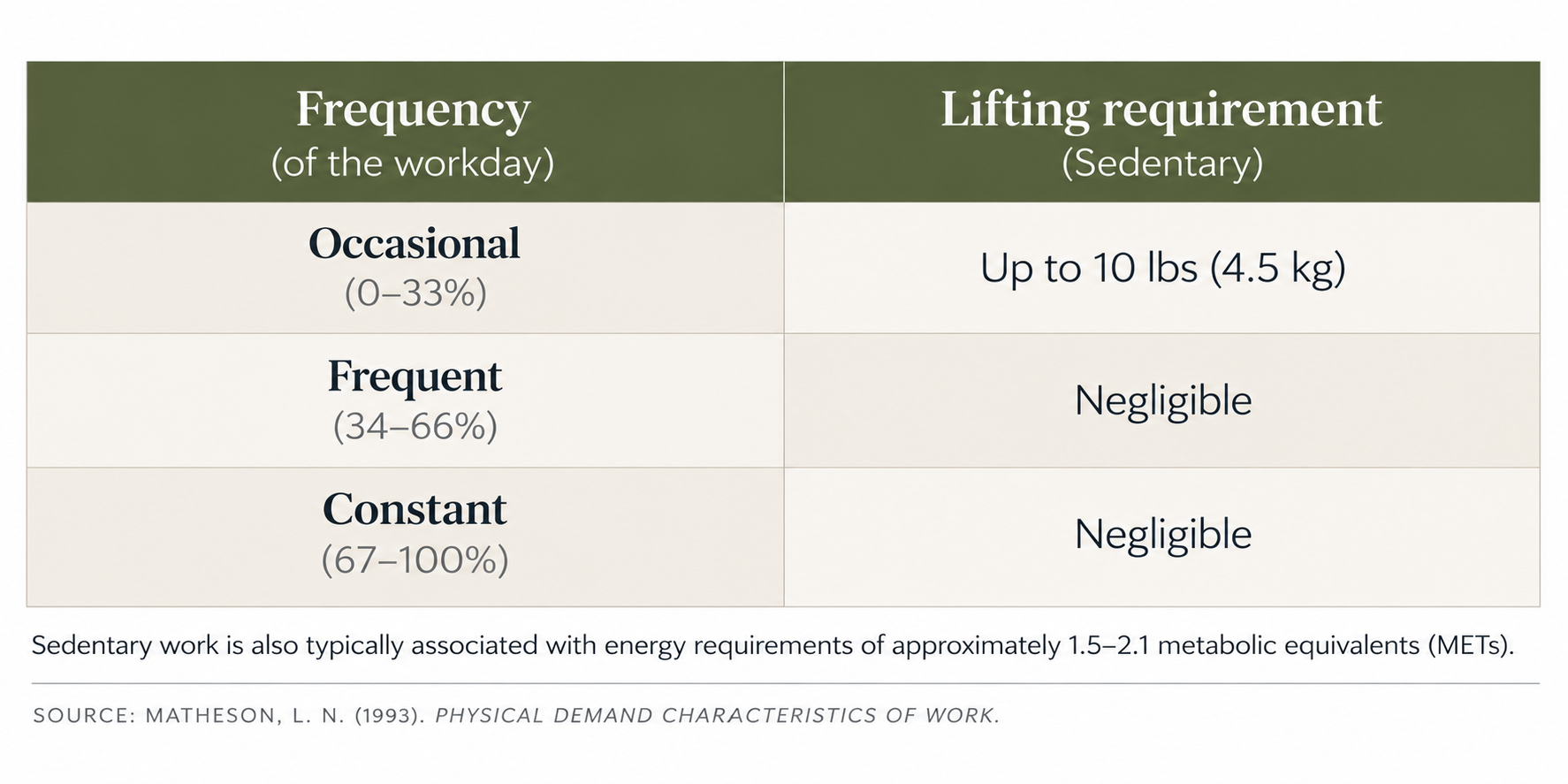
Under this framework, sedentary work is associated with the following physical demands:
PHYSICAL DEMAND CHARACTERISTICS OF WORK
1993 Leonard N. Matheson, PhD
For a more detailed discussion of the relationship between OaSIS strength ratings and Matheson's Physical Demand Characteristics framework, see our earlier article, Tracing the Source: OaSIS Physical Strength Ratings and the Matheson PDC.
The framework also associates sedentary work with typical energy requirements of approximately 1.5–2.1 metabolic equivalents (METs).
These criteria describe the physical effort associated with work. However, the classification should not be treated as a complete description of every positional requirement of an occupation.
An occupation may involve very little lifting while still requiring considerable standing, walking, or other physical activity.
How OaSIS Approaches Sedentary Work
Canada's Occupational and Skills Information System (OaSIS) describes occupations using a range of descriptors, including physical abilities, work activities, and body positions.
Within the OaSIS Canadian Rating Guide for Abilities, Static Strength Level 1 uses the same weight-by-frequency thresholds as Matheson's Sedentary physical demands classification: up to 10 pounds occasionally, with negligible lifting frequently or constantly.
However, OaSIS does not formally classify occupations as sedentary.
In correspondence with HM Vocational Consulting, Employment and Social Development Canada (ESDC) clarified that OaSIS does not treat sedentary work as a single construct. Instead, occupational characteristics are described through separate dimensions.
For example:
Static Strength describes the muscle force required to lift, push, pull, carry, or transfer objects.
Sitting describes the extent to which an occupation requires a seated position.
Other relevant physical abilities, work activities, and body positions may also need to be considered.
An occupation may therefore have sedentary-level strength requirements without being performed predominantly while sitting.
Considering these characteristics separately can help vocational evaluators compare an individual's documented functional restrictions and limitations with the general physical demands of potential occupations. Where necessary, the actual demands of a specific job should also be investigated.
Low Strength Requirements Do Not Always Mean Seated Work
Consider the occupation of hairstylist.
Hairstyling may involve relatively low strength requirements while also requiring prolonged standing. The actual demands will depend on the duties and work setting.
An individual who has a restriction limiting lifting to 10 pounds may be capable of meeting certain strength requirements of the occupation. However, if that same individual is restricted from prolonged standing, the occupation may not be suitable without further consideration of its actual demands and potential accommodations.
The reverse can also occur.
An occupation may involve prolonged sitting with very little lifting, but that does not automatically make it suitable for someone who has limited sitting tolerance or requires frequent positional changes.
These examples illustrate why strength requirements and body positions need to be considered independently rather than relying on a single descriptive term.
Why Clarifying Referral Instructions Matters
In vocational practice, referral sources may request the identification of sedentary occupations without specifying which characteristics they intend the term to represent.
For example, a disability case manager may be seeking occupations that involve minimal lifting because of an individual's upper-extremity restrictions. Another may be looking for occupations performed primarily while seated because the individual has limited standing and walking tolerance.
Although both requests may use the same terminology, they can lead to different occupational considerations.
Where the intended meaning is unclear, confirming the referral source's expectations can help establish the appropriate parameters for the assessment.
It is equally important to distinguish between referral instructions and the individual's documented functional restrictions and limitations. Clarifying terminology does not replace the need to evaluate occupations against the applicable functional information.
Implications for Vocational Assessment and Return-to-Work Planning
Physical demands classifications are useful tools for occupational analysis, but they are only one component of determining vocational suitability.
Depending on the referral questions and available information, an evaluation may also need to consider:
The frequency and duration of sitting, standing, and walking.
Lifting, carrying, pushing, and pulling requirements.
Opportunities to alternate positions or take breaks.
Repetitive movements and postural requirements.
Differences between general occupational descriptions and the demands of a particular job.
Whether reasonable workplace accommodations could address identified barriers.
For disability case managers, insurers, vocational evaluators, and return-to-work professionals, understanding these distinctions can support clearer communication and more informed occupational recommendations.
An occupation with sedentary-level strength demands should not automatically be considered suitable for someone whose restrictions require predominantly seated work. Likewise, an occupation performed primarily while seated may present other physical demands that require consideration.
A Shared Understanding Supports Better Decisions
The term sedentary remains useful in vocational practice, particularly when referring to established physical demands classifications such as Matheson's framework.
The challenge arises when the term is used without clarifying whether it refers to strength requirements, body position, or both.
Sometimes, a simple clarification at the referral stage can prevent misunderstandings later in the assessment process.
Ultimately, the objective is not simply to identify occupations that fit a particular classification. It is to understand the actual demands of those occupations and consider whether they are consistent with the individual's documented functional abilities, restrictions, and limitations.
Clear terminology is an important part of that process.
References and Resources
Matheson, L. N. (1993). Physical Demand Characteristics of Work.
Employment and Social Development Canada. (2024). OaSIS Canadian Rating Guide for Abilities (Version 2.0, August 20, 2024).
Occupational and Skills Information System (OaSIS): https://noc.esdc.gc.ca/OaSIS/OaSISOccProfile
About HM Vocational Consulting
HM Vocational Consulting provides vocational rehabilitation, transferable skills analysis, employment and career planning, return-to-work planning, and professional practice development services across Canada.
Our approach emphasizes individualized vocational planning, evidence-informed practice and collaboration to identify and address employment barriers.
Heather Mallard, CVRP-TSA, ICVE, CCVE, RVP, Vocational Evaluator & Rehabilitation Professional | HM Vocational Consulting
About the Author Heather Mallard is a vocational evaluator and rehabilitation professional and the founder of HM Vocational Consulting. Her work focuses on vocational assessment, rehabilitation, return to work, and the relationship between work, identity and meaning.
