Revisiting Vocational Assessment Levels: What Do Our Definitions Really Mean in Canadian Practice?
Mar 5 2026
In the world of vocational rehabilitation, we use terms like “vocational assessment” and “vocational evaluation” every single day. But if you look closely at how these services are delivered across Canada, there is a surprising amount of variation in what those words actually mean in practice.
A recent Delphi study in the VECAP Journal revisited the classic "Three Levels" of vocational assessment, producing updated, consensus-based definitions. Meanwhile, Canadian credentialing bodies like the CVRP and organizations like CAVEWAS continue to reference the foundational definitions many of us were trained on.
Is it time to sync our language? Let’s walk through where these levels came from, how they are evolving, and why "quality of life" is becoming a central pillar of our work.
The Foundation: Crow and Dowd’s Three-Level Model
The tiered approach isn't new; it traces back to Crow (1975) and Dowd (1993). This framework has long served as the "north star" for Canadian practitioners, especially within CVRP’s CCVE/ ICVE-related materials.
Level I – Screening / Needs Assessment: Initial process to decide if further services are required. Includes interviews and limited psychometrics.
Level II – Clinical / Exploratory Assessment: An intermediate process involving detailed case reviews, transferable skills analysis (TSA), and in-depth counseling.
Level III – Comprehensive Vocational Evaluation: The most intensive process, using real or simulated work as the focal point, incorporating medical, social, and economic data.
The New VECAP Delphi Study: Modernizing the Model
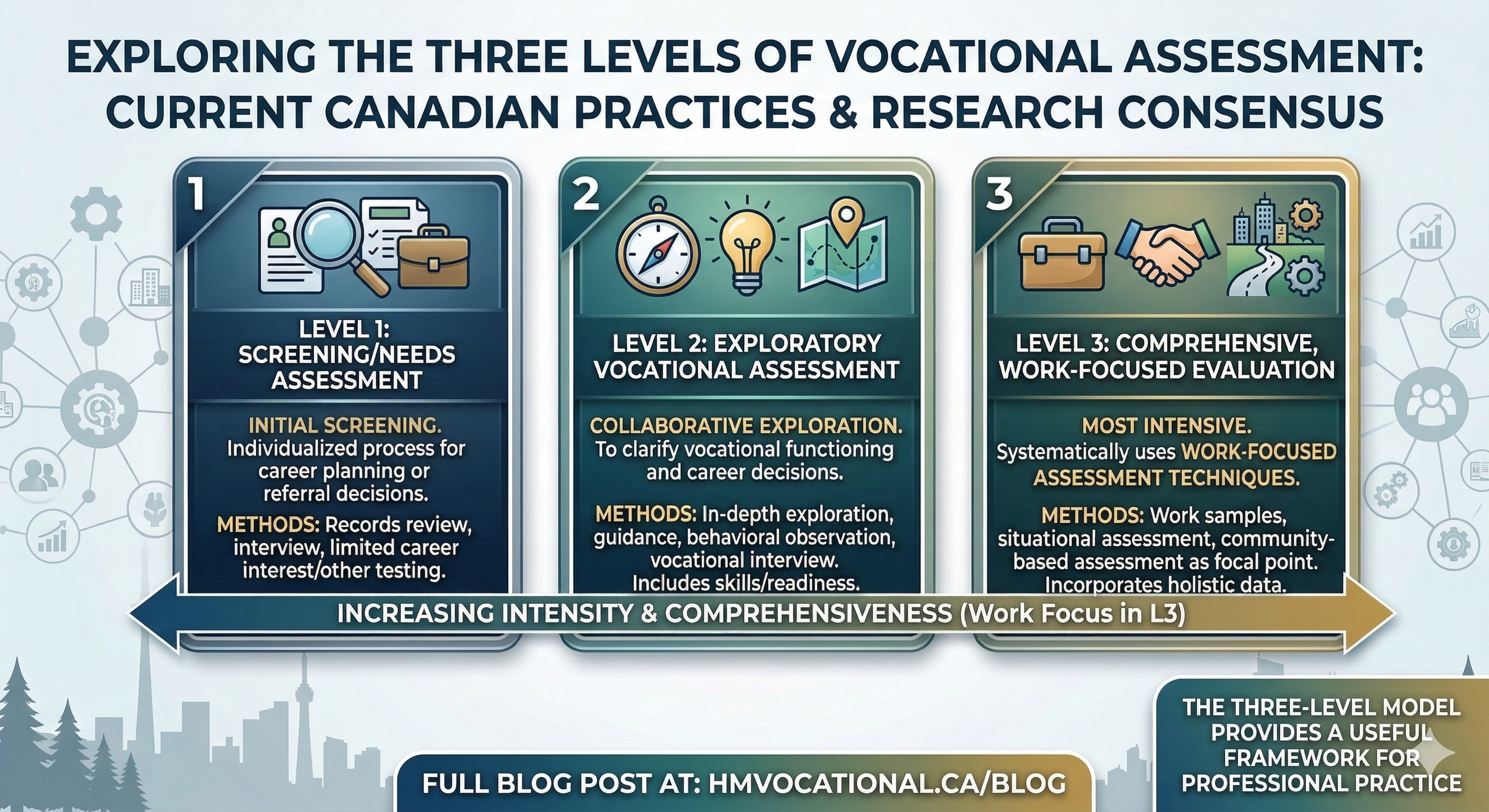
The recent Delphi study kept the three-level structure but refined the definitions to reflect modern practice. Here is the breakdown of the updated standards:
1. Level One: Screening & Needs Assessment
The least intensive tier. It is an individualized process designed to support immediate career decisions or determine if a deeper dive is necessary.
Methods: Records review, personal interviews, and limited interest testing.
2. Level Two: Exploratory Vocational Assessment
This is a collaborative space. It isn't just "Level Three Lite"—it is a distinct process of guided exploration to clarify vocational functioning.
Methods: Behavioral observation, work readiness assessment, and in-depth career guidance.
3. Level Three: Comprehensive, Work-Focused Evaluation
The differentiator here is the work-focused technique. To be a true Level Three, the evaluation should use work samples, situational assessments, or community-based assessments as the focal point.
Outcome: Specific recommendations for career goals or quality-of-life goals.
The Big Shift: The Delphi study clarifies that Level Two is defined by collaboration and exploration, while Level Three is defined by work-focused methods—not just the volume of tests administered.
The Canadian Context: CVRP and CAVEWAS
How does this global research sit alongside our home-grown standards?
CVRP / ICVE: The College’s materials remain highly consistent with the Delphi model. The new study doesn’t overturn the CVRP structure; it simply sharpens the tools, emphasizing behavioral observation and making the "work-focused" nature of Level Three more explicit.
CAVEWAS: While CAVEWAS doesn’t always use the "three levels" labels in public documents, their distinction between Assessment (appraising functioning) and Evaluation (a comprehensive roadmap) aligns almost perfectly with the Delphi Level Three criteria.
Beyond the Paycheck: The "Quality of Life" Factor
One of the most significant additions to the new definitions is the explicit mention of Quality of Life (QoL).
In Canadian practice, we know that employment is only one part of the puzzle. A successful vocational outcome must also consider stability and sustainability. Integrating QoL into our definitions means:
Linking recommendations to daily functioning (energy management, commute feasibility).
Considering how work arrangements impact broader health.
Including the client’s definition of a "good life" within our professional scope.
How Are We Actually Using These Levels?
In Canada, many of us use these levels as a "mental map" rather than explicit labels in a report. However, adopting these clearer definitions can help us:
Triage Better: Decide faster if a referral needs a Level One screen or a Level Three evaluation.
Communicate with Referrers: Clearly explain why a "Vocational Evaluation" costs more and takes longer than a "Vocational Assessment."
Audit Quality: Ensure that if we call a report "comprehensive," it actually includes the work-focused methods required for that level.
Questions for Reflection
As we move forward, Canadian practitioners should consider:
Service Design: Do your current service descriptions match these updated definitions?
Feasibility: How easily can you integrate community-based or situational assessments into your Level Three work?
The Gap: Where is the biggest disconnect between these definitions and the reality of your funding or referral sources?
By sharpening our language, we don't just improve our reports—we strengthen the entire evidence base for vocational rehabilitation in Canada.